
Locksmith Work for Facility Managers and Commercial Property Owners in Albuquerque
If you are the person who gets the call when a tenant leaves, a key goes missing or a door stops working, this page is for you. Roadrunner Lock and Key serves commercial property owners and facility managers across Albuquerque: office buildings, retail centers, warehouses and buildings with several tenants. The work is mostly planned: keying, records, turnover rekeys and hardware repair, priced on the phone before anyone drives out.
The difference between a facility job and a one-off business call is scale and memory. A shop owner usually has a handful of doors and knows every key. A property you manage might have dozens of doors, several tenants with their own staff, a cleaning crew, an HVAC contractor and a previous manager who left a drawer full of unlabeled keys. The lock work itself is the same rekeying and repair any locksmith does. What changes is the plan around it: who should open what, how you will know, and how to change it later without starting over.
If your problem right now is a locked door with people waiting outside, that is a lockout, and our commercial locksmith and business lockout page covers it. If you manage apartments, rental homes or residential units, see the locksmith page for property managers. This page is about running the keys of a commercial building over months and years.
Planning lock work across a building? Call for a phone quote on the whole list.
Call (505) 347-2895Key Control for Commercial Buildings: Records, Audits and Storage
Key control means you can answer three questions on any day: which keys exist, who holds each one, and which doors each key opens. Most buildings lose that answer slowly, one unreturned key at a time. The fix is a written key record, a locked place for spare and master keys, and a habit of checking the record against the keys you can actually find.
Start the record with what you have. Lay the keys out, note the number or code stamped on each one, and test them against the doors. A key that opens nothing on the property still goes in the log as unknown, because it may open something you have not tried. Then list the people: tenants, your staff, the cleaning company, vendors with recurring access. For each, write the key, the date it went out and the date it came back.
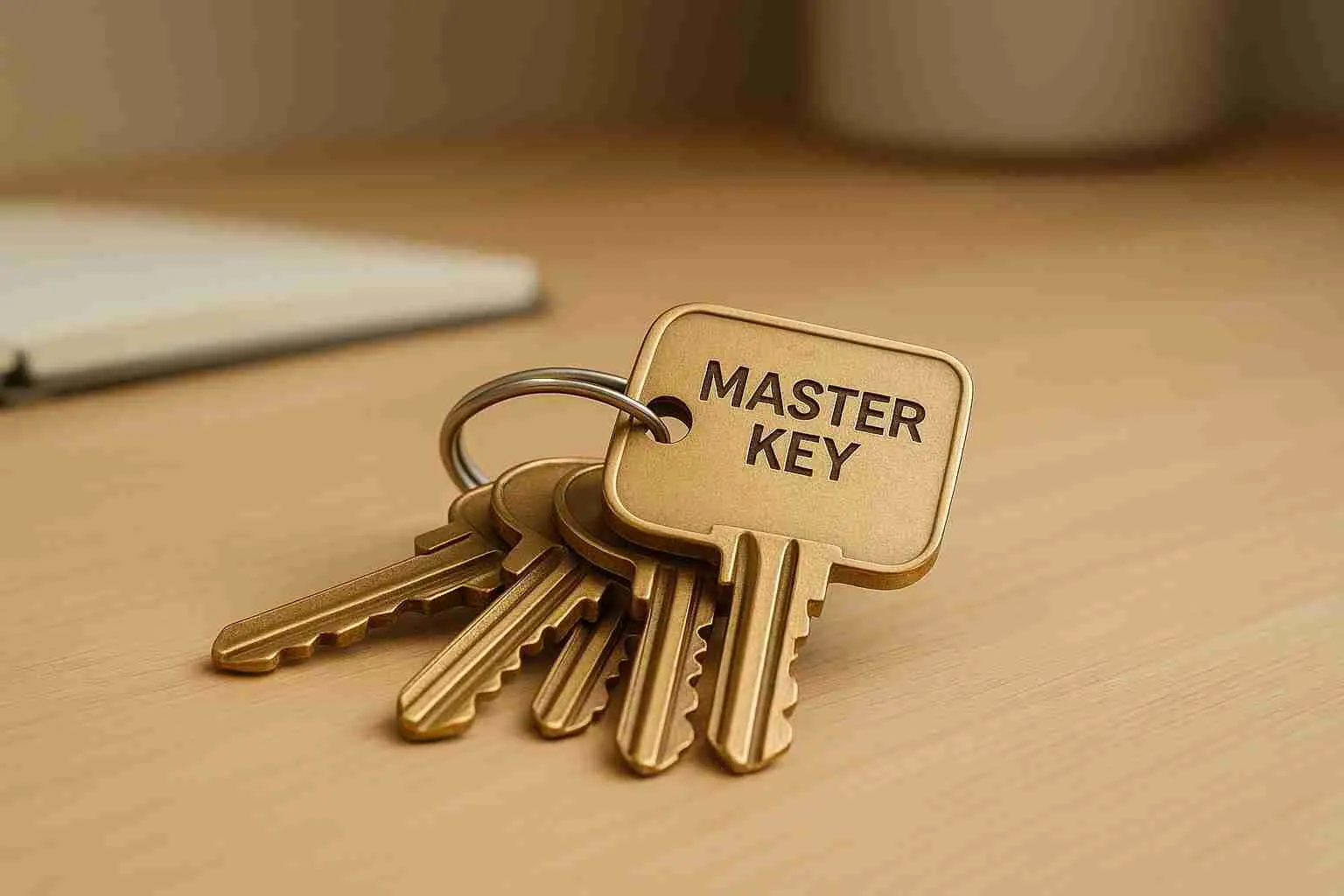
Storage matters as much as the log. A master key on a pegboard in an unlocked office is not controlled, whatever the spreadsheet says. Keep master and spare keys in a locked key cabinet or lockbox that only a few people can open, and label keys with a code rather than "Master" or "Roof." Our guide to master key system risks covers storage, logs and audits in more depth.
A key record that holds up
- Key code or number stamped on the key, not a description.
- Doors it opens, by suite number or room name.
- Holder, with company and phone for vendors and tenants.
- Date issued and date returned, plus a signature if you can get one.
- Audit date: the last time someone checked the keys against the record.
Master and Grand Master Key Hierarchies Across Tenants
A grand master key system has levels. A change key opens one lock, such as a single office door. A master key opens a group, such as every door in one tenant's suite. The grand master opens every group, usually the whole building. Each level is planned on paper first, so every key opens exactly what it should. Roadrunner Lock and Key sets up these systems for Albuquerque properties.
In a multi-tenant building, the levels usually follow the lease. Each tenant gets a master for their own suite, so their manager can carry one key while their staff carry change keys for their own offices. The building side gets a separate master for common areas and service rooms. The grand master, which opens both, stays with the owner or the facility manager and as few other people as possible.
The trade-off is real. A lock on a master system accepts more than one key, and a lost grand master means rekeying every lock it opened. That is why the plan should be built from the top down and written down before any lock is changed: a list of every door, the group it belongs to, and which keys open it. Rekeying a suite later is much simpler when the plan already says where that suite sits.
How the levels compare
- Change key: one lock or a small set keyed alike. Typical holder: an employee or a tenant's staff member.
- Master key: one group of locks, such as a suite or a floor. Typical holder: a tenant's office manager or a building engineer.
- Grand master key: every group in the system. Typical holder: the owner or facility manager, kept to the smallest list possible.
Restricted Keyways: Controlling Who Can Copy a Building Key
A restricted keyway is a key profile whose blanks are not sold to the public. Copies come only through authorized dealers, who check the request against the property's authorization before cutting. A standard key can be copied at most hardware stores, so on a standard keyway your key log only records the keys you handed out, not the copies made after. For master keys, that gap is the whole risk.
Here is the plain comparison. A non-restricted keyway is cheap and convenient, and anyone holding a key can copy it. A restricted or patented keyway costs more and adds a step to every copy, but the copy goes through someone who checks. Many buildings mix the two: restricted keys for the grand master, masters and exterior doors, standard keys for interior offices where a stray copy matters less.
A key stamped "Do Not Duplicate" is not the same thing. The stamp is a request, and it does not change the blank. If you are weighing a restricted system, tell us on the call how many doors and how many key holders are involved, and we will talk through whether it fits your building. The guide to common weaknesses in high-security locks explains why key control matters as much as the lock itself.
Rekeying a Commercial Suite After a Tenant Moves Out
When a commercial tenant moves out, rekey the suite before the next tenant gets keys. The old tenant's staff, cleaners and vendors may all have copies, and there is no way to collect them all. Rekeying changes the pins inside each lock so every old key stops working, and the hardware stays. Roadrunner Lock and Key can rekey every door in a suite on one visit, with the price quoted on the phone first.
Do the walk-through on move-out day. Collect what keys come back, note which ones did not, and check every door that belonged to the suite: the main entry, interior offices, storage rooms, a private restroom and any rear or service door that opens into the suite. Rear doors get missed more than any other, because nobody walks past them.
If the building is on a master system, say so when you call. The suite's new keying has to fit the existing plan so your building master still opens it. Then hand the new tenant their keys, log them, and record which keys were never returned by the last one. Read rekeying vs lock replacement if some of the suite's locks are worn enough to replace instead.
Turnover checklist for a commercial suite
- Collect returned keys and list the ones that did not come back.
- Walk every door in the suite, including rear and service doors.
- Note any lock that sticks, will not latch or has a damaged cylinder.
- Call (505) 347-2895 with the door count and whether the building is master keyed.
- Issue new keys only after the rekey, and log each one.
Tenant moving out? Call with the door count for a rekey quote.
Call (505) 347-2895Common Areas vs Tenant Suites: Which Doors Belong to the Building
In most commercial leases, the building controls the common areas and the tenant controls its own suite. Common areas usually include the lobby and entry doors, corridors, shared restrooms, stairwells, mechanical and electrical rooms, roof access and the loading dock. Those locks belong on the building's side of the key plan, and tenant keys should open only the common doors they actually need to use.
The lease decides the edge cases, so read it before anyone changes a lock. Some leases let a tenant change the locks on its own suite; others require the landlord's approval or require that the landlord keep a working key. If a tenant swaps a suite lock with no building key, your master stops working on that door and you may have no way in during an emergency or a maintenance call.
Shared doors are where key counts grow fastest. A back corridor door used by three tenants means three sets of tenant keys, plus cleaning and maintenance. A master system keeps that manageable, because each tenant master can be set to open the shared door without opening anyone else's suite. When you call us, tell us whether you are the owner, the manager or a tenant, and which side of the lease the door is on.
Planning Lock Work Around Business Hours
Planned lock work in an occupied building has to fit around the tenants. Roadrunner Lock and Key answers the phone 24 hours a day, 7 days a week, so you can ask for work before opening or after close and get a straight answer on the call about timing. Rekeying takes each cylinder out of its door for a short time, so plan which doors can be open during the work.
Tell the tenants ahead of time. Give them the date, which doors are affected, and when the new keys will be handed out. For a suite rekey, the tenant's manager should be there or should name someone who will be, so the new keys go to the right person and nobody is left with a key that no longer works.
Keep the building secure during the work. Exterior doors, the main entry of an occupied suite and any room holding cash, records or stock should not sit unlocked and unattended while the job moves door to door. Give whoever meets us a list of doors in the order you want them done, and the name of the person who will sign for the new keys.
Storefront Door Locks in Retail Centers
Retail centers in Albuquerque often use aluminum-framed glass storefront doors. These doors have a narrow frame, so they use a narrow lock body set inside the frame, usually a deadbolt with a key cylinder outside and a key cylinder or thumbturn inside. Because the frame is thin, the wrong replacement lock will not fit, and a lock that only half throws is a common problem.
A storefront deadbolt that will not lock usually comes back to one of three things: the door has dropped and the bolt no longer lines up with the frame, the cylinder is worn or stiff, or the bolt mechanism itself is failing. The first is a door alignment issue; the other two are lock repair or replacement. The guide to common problems with commercial door locks walks through the signs.
In a retail center, storefront cylinders also belong in the key plan. Each tenant's front door is usually on the tenant's side, but the owner may want a building key that opens every storefront for emergencies. If you are rekeying a center, count the storefront doors separately from the steel back doors when you call, because the hardware is different.
Push Bars, Door Closers and Other Hardware: Describe It on the Call
Commercial doors carry more than a lock. Exit devices, often called push bars, let people leave in one push. Door closers pull the door shut. Electric strikes and maglocks work with access control. If one of these is the problem, describe it on the call: what the hardware is, what it does wrong, and how many doors have it. We will tell you on the phone whether it is a job we take.
Exit doors carry fire and life-safety rules, so any change to how they lock or release should match the code that applies to your building and your fire marshal's requirements. That is a reason to describe the door carefully rather than guess. Useful details: whether the push bar has a key cylinder on it, whether the door is the main exit or a rear one, and whether the problem is the door not latching, not opening or not closing.
Many latching problems that look like lock failures are really the door or its closer. If the door does not close fully on its own, the latch never reaches the strike, and a new lock will not fix that. Mention it, and we will help you work out whether it is a lock problem or something else.
Door Hardware Repair Across a Building: Work From One List
For a building with many doors, the fastest way to get worn hardware fixed is one list. Walk the property, write down each door that sticks, will not latch, has a loose lever or has a cylinder that fights the key, and ask for one quote on the whole list. Roadrunner Lock and Key repairs or replaces worn commercial locks, and one list lets us price the work as one job.
Commercial locks are graded for durability under the ANSI/BHMA standard, with Grade 1 the heaviest duty. High-traffic doors, such as the main entry, a shared corridor door or a storeroom used all day, wear faster than an office door opened twice a day. When a door on your list has failed more than once, it may be worth asking whether a heavier-grade lock belongs there.
A simple maintenance habit catches problems before they become failures: test each exterior and common-area lock on a set schedule, clean stiff cylinders with a graphite or silicone lubricant rather than oil, and tighten loose strike plate and hinge screws. Our lock maintenance guide lists the tools and steps.
How Quotes for Multi-Door Work Happen on the Phone
Roadrunner Lock and Key quotes every job on the phone before anyone drives out, and multi-door work is no different. You describe the property, the doors and what you want done, and we give you the price on the call. We do not post fixed prices, because a building rekey depends on the number of doors, the lock types and whether the work has to fit an existing master system.
The quote is only as good as the description. The number of doors sets most of the scope. The lock brands and types set the parts. Whether the property is already master keyed, and whether you want a new hierarchy or changes to the current one, sets the planning. Locks that are worn or damaged may need replacing instead of rekeying, which changes the price, so mention them.
Ask for the total, and make sure the price at the door matches the price on the phone. A quote that only appears once the technician is on site is a red flag with any locksmith. Our article on what a locksmith costs in Albuquerque explains how to spot a bait quote.
What to Have Ready Before You Call
A few minutes of preparation turns a vague estimate into a firm phone quote. Before calling (505) 347-2895, count the doors involved, note the brand name on the face of the locks, and find out whether the building is already on a master key system. If you have a key record, have it open. If you do not, say so, and we will start from what you can describe.
Checklist for a facility quote
- Property address and the type of building: office, retail center, warehouse or mixed.
- Door count, split by type: glass storefront, steel exterior, interior office, roll-up or gate.
- Lock brands printed on the lock face or the key bow, if you can read them.
- Master system status: whether one exists, and who holds the master and grand master keys.
- The goal: a suite rekey, a new hierarchy, repairs on a list of doors, or a mix.
- Timing limits: tenant hours, doors that must stay secure, and who will meet us.
- Problem hardware: push bars, closers or locks that already stick, described in a sentence each.
List ready? Call (505) 347-2895 and get the price on the phone.
Call (505) 347-2895Warehouses and Industrial Buildings: Steel Doors, Gates and Padlocks
Warehouses add doors that office buildings do not have: steel personnel doors beside loading docks, gates in the yard fence, padlocks on cages and roll-up doors. Each is a lock somebody holds a key to, so each belongs in the key record. Count them separately when you call, because a building with twelve doors and twenty padlocks is a different job from twelve doors alone.
The same key control rules apply. Decide which shift leads, drivers and vendors need which doors, and keep the list short for anything that opens the whole site. Yard gates and dock doors tend to collect the most unreturned keys, because drivers and temporary staff come and go. If a door on the site changes hands every few weeks, ask whether a keypad would save you the rekeys.
Who Answers When You Call Roadrunner Lock and Key
Roadrunner Lock and Key is a locally owned locksmith, owned by Genaro Vasquez, with its shop address at 3803 3rd St NW in Albuquerque and a 505 phone number. Facility managers can check the same things they would check on any vendor: a street address on Google Maps, a local number, and a price stated before anyone drives out. Our Google Business Profile shows the address and reviews.
Besides Albuquerque, we cover Rio Rancho, Corrales, Bernalillo, Placitas, Cedar Crest, Los Lunas, Belen and Santa Fe. Properties farther from the shop mean a longer drive, so the phone call is where you get the price and a real arrival time for that address. See the town pages for Albuquerque, Rio Rancho, Los Lunas and Santa Fe, or our residential locksmith services for homes.
