Locksmith Guides25 min read
Deadbolt vs Regular Lock: Which Is More Secure

By Roadrunner Lock and Key ·
A deadbolt is more secure than a regular knob lock because of how its bolt holds the door. That is the real difference between a deadbolt and a knob lock: a knob lock's spring latch can be forced back into the lock by end pressure, which is how a card or blade slips it, while a deadbolt's bolt does not retract with end pressure until a key or thumbturn moves it.[1]
Those latch and deadbolt definitions come from the Builders Hardware Manufacturers Association (BHMA), which writes the ANSI/BHMA standards for door hardware. Its residential standard, ANSI/BHMA A156.40 (approved January 15, 2015), grades each deadbolt separately for Durability, Strength and Security, and Finish, and a lock must meet every test for its grade in each category.[2] What most deadbolt vs knob lock guides leave out is what BHMA itself warns: lab results assume a good install, and in real doors "results vary because of installation, door and frame construction, maintenance and environmental conditions".[2] This guide explains the grades and gives you the strike-plate check that decides how strong your deadbolt really is.
When it comes to securing your home, deadbolts offer far greater protection than regular locks. Regular locks, often found in doorknobs or levers, are convenient and affordable but provide only basic security. Deadbolts, with their solid metal bolts and robust design, are far more resistant to forced entry, lock-picking, and wear over time.
Key Differences:
- Regular Locks: Easy to install, affordable, and ideal for interior doors where privacy matters more than security. However, they’re vulnerable to picking, bumping, and physical force.
- Deadbolts: Built for strength, they’re essential for exterior doors. They resist tampering and forced entry, and high-security options include features like anti-pick pins and reinforced strike plates.
Quick Tip: For maximum security, pair a regular lock with a deadbolt on exterior doors. This combination balances convenience with strong defense.
| Feature | Regular Lock | Deadbolt |
|---|---|---|
| Security | Low; a spring latch can be forced or shimmed open | High; the bolt resists force and shimming |
| Durability | Prone to wear over time | Long-lasting with minimal upkeep |
| Cost | Usually the cheaper of the two | Usually costs more; HomeYou's published Albuquerque range for a locksmith lock installation is about $40 to $100 plus $15 to $40 labor (updated September 27, 2026), a third-party figure, not Roadrunner's price[3] |
| Best Use | Interior doors | Exterior doors |
Choose based on your needs: regular locks for interior spaces, deadbolts for areas requiring stronger security. Pairing both on exterior doors ensures peace of mind.
What Are Regular Door Locks?
A regular door lock is a knob or lever lockset that holds the door shut with a spring latch bolt. BHMA defines a latch bolt as a beveled bolt that "may be forced back into the lock case by end pressure".[1] A deadlatch adds a small plunger that locks the latch against that end pressure once the door is closed, so it resists a slipped card better than a plain latch.[1]
Regular door locks, often called spring bolt or latch locks, are among the most commonly used types of locks. These locks are typically integrated into doorknobs or lever handles and rely on a straightforward, spring-loaded mechanism. When the handle is turned, the spring retracts the latch, allowing the door to open.
You’ll often find these locks in residential interiors, such as bedrooms, bathrooms, hallways, and closets. They’re also frequently used on cabinets, drawers, mailboxes, and wardrobe doors, places where the primary goal is to ensure basic privacy rather than high-level security. In some cases, variations like wall-mounted locks are used for sliding doors or as additional security measures alongside more robust locking systems.
In commercial settings, lever handle locks with spring mechanisms are especially popular. They’re user-friendly and provide better accessibility for people with mobility challenges, including seniors and individuals with disabilities.
That accessibility point has a federal basis. In covered public buildings, the 2010 ADA Standards say "Operable parts shall be operable with one hand and shall not require tight grasping, pinching, or twisting of the wrist" and that door hardware must sit 34 to 48 inches above the floor.[7] A round knob takes a twist; a lever does not. Private single-family homes are outside that rule, but the same logic helps anyone with arthritis.
How Regular Locks Work
Here’s how a regular lock functions: when the door is closed, a spring-loaded latch extends into the strike plate on the door frame, securing the door in place. To open the door, turning the handle compresses the spring and retracts the latch, allowing the door to swing freely.
These locks don’t require a key to engage from the inside, simply closing the door activates the latch.
Main Features of Regular Locks
Regular locks are affordable, easy to install, and well-suited for interior spaces. They’re a practical choice for areas where quick access and basic privacy are priorities, such as bedrooms, bathrooms, or other high-traffic spaces. Their simple mechanism ensures convenience without the need for complex unlocking procedures.
However, the trade-off for this convenience is lower security. Regular locks are relatively easy to bypass using techniques like picking or bumping, and their spring mechanisms can weaken over time. They’re not designed to withstand significant force, so relying on them as the sole security measure for exterior doors or critical entry points isn’t advisable.
That said, pairing a regular lock with a deadbolt on an exterior door can create a solid combination. The regular lock provides ease of use for daily access, while the deadbolt adds the necessary strength to enhance security.
Latch, Deadlatch and Deadbolt Compared
The three bolts look alike from the hallway. They behave very differently when someone pushes on them.
| Feature | Spring latch (most knob locks) | Deadlatch | Deadbolt |
|---|---|---|---|
| How it moves | Spring pushes it out; end pressure can push it back[1] | Spring latch plus a plunger that locks it against end pressure once the door closes[1] | Thrown by key or thumbturn; does not retract with end pressure[1] |
| Holds the door closed by itself | Yes | Yes | No, you throw it |
| Minimum throw where a code sets one | No number in the codes read for this guide | 1/2 inch on apartment unit doors (San Mateo, CA)[5] | 1 inch on house exterior doors (San Mateo, CA)[4] |
| Most common way it fails | Slipped with a card or blade, or pried | Pried at the gap between door and frame | The strike plate and jamb give way when the door is kicked[6] |
| Best use | Interior doors and everyday latching | Doors that must lock themselves when they close | Every exterior door |
Next, we’ll take a closer look at how deadbolts differ in both design and the level of protection they offer.
What Are Deadbolt Locks?
A deadbolt is an auxiliary lock whose bolt is moved only by a key or a thumbturn. BHMA's definition is exact: when the door is closed and the bolt thrown, "it extends into a hole provided in the strike thus locking the door. It does not retract with end pressure".[1] That one property is why a deadbolt locks a door and a spring latch only holds it shut.
Deadbolt locks are a reliable choice for securing your home or property. They use a solid bolt that extends deep into the door frame, providing a strong defense against forced entry. Unlike standard locks, which rely on spring mechanisms, deadbolts stay firmly in place until you manually unlock them with a key or thumb turn. This simple yet effective design makes them much harder to bypass.
How Deadbolts Work
Deadbolts operate through a straightforward mechanism. When you turn the key or thumb turn, the heavy bolt slides into the door frame, locking it securely. Unlike spring-based locks, deadbolts require deliberate action to engage or disengage, which significantly improves their resistance to tampering or break-ins. Up next, we'll explore the various types of deadbolts and the unique security benefits they offer.
Single-Cylinder, Double-Cylinder and Keypad Deadbolts
A single-cylinder deadbolt has a key outside and a thumbturn inside, and BHMA's homeowner site calls it "The most common deadbolt used for households".[8] A double-cylinder deadbolt needs a key on both sides.[1] An electronic or keypad deadbolt replaces the outside key with a code.[8]
Double-cylinder deadbolts stop a burglar who breaks the glass next to a door and reaches for the thumbturn. Seattle Police recommend them for doors where breaking adjacent glass gives access to the lock, and warn: "Never leave the key in the lock".[6]
Here is the catch in New Mexico. The state adopted the 2021 International Residential Code, effective July 14, 2023,[9] and that code says "Egress doors shall be readily openable from inside the dwelling without the use of a key or special knowledge or effort".[10] Building codes are adopted and enforced locally, so ask your building official before you put a double-cylinder deadbolt on the door you would use to get out in a fire.
Upgrade your front door locks. We will quote the exact price on the phone before we come. Call (505) 347-2895
See our residential locksmith services.
Security Comparison: Regular Locks vs. Deadbolts
A deadbolt beats a knob lock against force, but the lock is rarely what fails. Seattle Police say the most common way to force a door with a wooden jamb is to kick it, and "The weakest point is almost always the strike plate that holds the latch or lock bolt in place".[6] A deadbolt is only as strong as its strike plate screws.
When it comes to safeguarding your home, understanding how regular locks and deadbolts hold up against potential threats is essential. Both types of locks face different challenges, from brute force to skilled manipulation. Here's a closer look at how they compare across key security factors.
Protection Against Forced Entry
Regular locks, often equipped with spring-loaded mechanisms, provide limited resistance to forced entry. Their latches are prone to giving way under pressure, making them vulnerable to physical attacks like kicks or prying with basic tools.
Deadbolts, however, are built with strength in mind. The solid metal bolt extends deep into the door frame, creating a robust connection that's challenging to breach without causing obvious damage. In most cases, attempts to bypass a deadbolt result in damage to the door itself rather than the lock mechanism.
Protection Against Picking and Manipulation
Standard locks, such as knob locks, spring bolt locks, and basic cylinder locks, are relatively easy targets for picking or bumping. Their design makes them susceptible to tampering with simple tools, often allowing intruders to bypass them without leaving clear signs of entry.
Picking and bumping attack the key cylinder, not the bolt, so a deadbolt with a standard pin-tumbler cylinder is about as easy to pick or bump as a knob with the same cylinder. Where a deadbolt wins is the bolt itself: it cannot be slipped back with a card or shim the way a plain spring latch can, and its longer throw resists force. For real pick and bump resistance, choose a cylinder built for it.
For even greater security, high-security deadbolts incorporate features like anti-pick pins and mechanisms to counter bump key attacks. Vertical deadbolts, also known as jimmy-proof deadbolts, lock into their strike so the door and frame cannot be pried apart at the lock. Many high-security models also include restricted key systems, which limit unauthorized duplication and add another layer of protection.
| Security Factor | Regular Door Lock | Deadbolt Door Lock |
|---|---|---|
| Resistance to Lock Picking & Bumping | Depends on the cylinder; a plain spring latch can also be shimmed | Depends on the cylinder; the bolt itself resists force and shimming |
| Mechanism Type | Spring-loaded latch, easily manipulated | Solid metal bolt without a spring mechanism, operated by a key or thumb turn |
| Anti-Manipulation Features | Minimal protection | High-security options include anti-pick pins, anti-bump mechanisms, and restricted key systems for added defense |
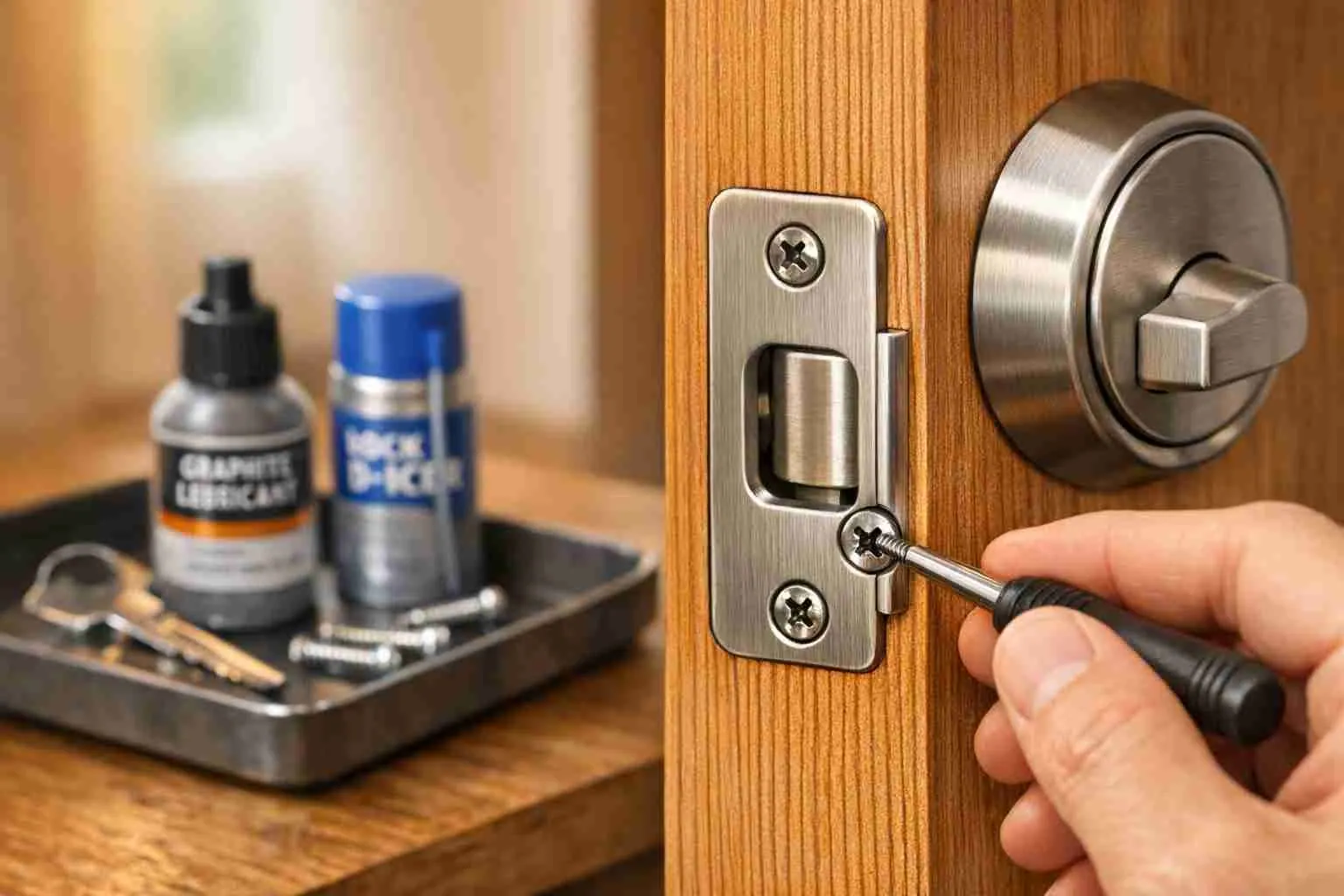
The One-Minute Strike Plate Check
Run this on every exterior door. You need a screwdriver and a tape measure.
- Open the door, throw the deadbolt, and measure how far the bolt sticks out. Seattle Police say deadbolt throws "should always be a minimum of 1” in length",[6] and San Mateo, California's code requires a 1 inch minimum throw on house exterior doors.[4]
- Close the door and back out one strike plate screw. A short screw only reaches the trim, and Seattle Police note "The average door strike plate is secured only to the doorframe molding".[6]
- Replace the strike plate screws with 3-inch to 4-inch wood screws that bite into the stud behind the jamb, as the Seattle Police bulletin recommends.[6] Where codes set a number, San Mateo requires deadbolt strike screws to reach at least 2 1/2 inches into solid backing.[4]
- Put long screws in the knob latch's strike plate too, and at least one long screw in each hinge.[6]
- If the jamb is split or soft, fix the frame before you buy a new lock.[6]
Lock Grades Explained: BHMA A156.40
Under ANSI/BHMA A156.40, the standard for residential deadbolts and deadlatches, a lock is rated separately in three categories: Strength and Security, Durability, and Finish.[2] Each category gets a C (Good), B (Better) or A (Best) on the BHMA rating label, and the lock must pass every test for its letter.[2][11] An AAA lock passed the top tests in all three; an ABC lock did not.
Commercial-style standards use numbers instead of letters. BHMA says its product grades run "grade 1, 2, or 3" with grade 1 the highest, set by progressive performance benchmarks in each ANSI/BHMA standard.[12] When a box says Grade 1, that number comes from one of those standards. When a deadbolt's label shows three letters such as "AAA" or "ABA," they come from A156.40.
| Rating system | Standard | Scale | What it tells you |
|---|---|---|---|
| Residential letters | ANSI/BHMA A156.40 (approved 2015-01-15)[2] | A (Best), B (Better), C (Good), per category[11] | Security, durability and finish rated separately |
| Commercial-style numbers | Other ANSI/BHMA standards[12] | Grade 1 (highest), 2, 3[12] | One overall performance grade |
What do the tests do? BHMA's homeowner site says security tests apply forces such as "impact, excessive torque and other methods" and that one lever test "receives five blows from a hammer".[8] Durability testing cycles a lock through "up to one million cycles of unlatching, closing and relatching".[13] These are lab numbers. As A156.40 itself says, real results vary with installation and the door and frame.[2] The strike plate matters as much as the letter.
For a front door, look for an A in Strength and Security. Durability matters most on the door your family uses all day.
Durability and Maintenance
A deadbolt usually outlasts a knob lock because its bolt has no spring that tires from daily latching. BHMA's durability testing measures exactly that: how well hardware "can withstand the demands of daily life over a lengthy period of time" and puts locks through "up to one million cycles of unlatching, closing and relatching".[13] Check the Durability letter on the label before you buy.
The lifespan and upkeep of your door lock can have a lasting impact on both your security and budget. Comparing the durability and maintenance needs of regular locks versus deadbolts can help you make a better-informed choice.
Long-Term Durability
Regular locks, such as knob locks or lever handle locks, tend to wear out faster due to their spring-loaded mechanisms. Over time, frequent use can lead to issues like loose handles, sticky latches, or even complete failure. These types of locks are particularly vulnerable because their moving parts endure constant stress.
Deadbolts, however, are designed to last. Made from sturdy materials like steel or brass, deadbolts rely on a solid metal bolt rather than a spring mechanism, reducing the likelihood of mechanical failure. Their solid construction makes them resistant to wear and tear.
High-security deadbolts take durability even further with features like hardened steel bolts, reinforced strike plates, and heavy-duty screws that can withstand drilling, picking, and physical attacks. The cylinders in top-tier deadbolts are often machined from steel with tight seals, making them even more resilient.
For the best in durability, Grade 1 deadbolts stand out. Tested to endure significant force, these locks are built for heavy, long-term use. Look for deadbolts crafted from solid brass or steel to ensure maximum durability and security.
Now, let’s explore how maintenance plays a role in keeping these locks functional over time.
Maintenance Needs
Deadbolts not only excel in durability but also require less maintenance compared to regular locks. Regular locks, with their complex spring-loaded mechanisms, often need frequent adjustments, tightening, or part replacements. Even a single forced-entry attempt can compromise their functionality, leading to costly repairs or replacements.
Deadbolts, thanks to their simpler and more robust design, demand minimal upkeep. Unlike regular door locks, deadbolts do not rely on a spring mechanism, making them more resistant to forced entry and therefore acting as a more secure option.
While extremely durable, deadbolts can occasionally require minor adjustments. For instance, shifts in the door frame caused by house settling might affect their alignment. Simple fixes, like adjusting the strike plate or realigning the door, are usually enough to restore smooth operation.
In contrast, regular locks are more prone to wear and tear from daily use and external forces, often requiring ongoing repairs or eventual replacement. Deadbolts, with their sturdy build, offer a more reliable and low-maintenance security solution that stands the test of time.
Cost and Installation Considerations
In Albuquerque, a locksmith's lock installation runs about $40 to $100, plus a labor charge of about $15 to $40, according to HomeYou's Albuquerque locksmith cost guide updated September 27, 2026.[3] Those are published third-party ranges, not Roadrunner's prices. The lock itself is extra, and its grade, cylinder type and finish move that price. Call (505) 347-2895 for the exact price first.
When choosing between regular locks and deadbolts, it’s important to weigh the cost and installation requirements against your security needs, budget, and skills. Both options come with varying price ranges and installation challenges that can impact your decision.
Installation Requirements
Regular locks, like knob locks or lever handle locks, are relatively simple to install. Their design is user-friendly, making them a good option for DIY enthusiasts. Most regular locks fit into standard pre-drilled door holes and require only basic tools, making the process straightforward for homeowners.
Deadbolts, on the other hand, require a higher level of precision during installation. Installing a deadbolt involves drilling specific holes for the lock and bolt, as well as creating a mortise in the door edge for the strike plate. While it’s possible to install a deadbolt yourself if you have the necessary tools and skills, the process is more complex. Mistakes during installation can reduce the lock’s effectiveness, which is why proper installation is so important. For vertical deadbolts, the process may involve even more extensive modifications to your door frame, adding to the complexity. If you’re unsure about your ability to handle the installation, hiring a professional can ensure the lock is installed correctly and functions as intended.
The standard holes are worth knowing before you shop. BHMA describes the usual bored prep as a round hole about 2 1/8 inches across in the face of the door and a 7/8 inch to 1 inch hole in the edge.[1] BHMA's homeowner site says "Most BHMA® products will be adjustable to the most common door preparations",[8] so a deadbolt can go in an existing knob hole, but a deadbolt does not latch, so the door will not stay shut when it is unlocked. Keep a knob or lever for latching and give the deadbolt its own hole, usually above the knob. For heights, see our guide on where to mount a deadbolt.
Ultimately, these installation needs can influence the overall cost of your project.
Price Comparison
Regular locks are usually the more budget-friendly option. Knob locks are often the least expensive, while lever handle locks tend to cost a bit more due to their design and functionality.
Deadbolts, however, come at a higher price point. What moves a deadbolt's price is the grade on its label, the cylinder type (single, double or keypad) and the finish, and a locksmith installation in Albuquerque adds about $40 to $100 plus $15 to $40 labor, per HomeYou's guide updated September 27, 2026.[3] That is a published third-party range, not Roadrunner's price. High-security deadbolts, featuring elements like hardened steel bolts and pick-resistant cylinders, are priced higher because of their advanced materials and engineering. Biometric locks that incorporate deadbolt mechanisms are typically the most expensive option. If you want to compare upgrade paths, our guide to high-security deadbolts covers them.
Asked "How much will it cost?" on the Roadrunner Lock and Key homepage, the shop answers: "It depends on the job, the vehicle or the lock, and where you are. Call and tell us what happened, and we will quote the exact price on the phone before we come. You decide before anyone gets in the van."
If you’re looking to save money, opting for DIY installation of a deadbolt can help reduce costs. However, investing in professional installation might be worth it to ensure the lock is properly installed and provides optimal security.
Striking a balance between your budget and security needs is essential. While a quality deadbolt may require a larger upfront investment, its durability and added protection can make it a worthwhile choice in the long run. Regular locks, though less expensive, may not provide the same level of security, so consider your priorities carefully when making your decision.
Which Lock Is Right for You?
Most exterior doors need both locks, not one or the other. The knob or lever latch holds the door closed every time it shuts, and the deadbolt locks it, because a deadbolt "does not retract with end pressure" while a latch bolt can be forced back.[1] If you have only a deadbolt, the door swings loose when unlocked; if you have only a knob lock, it can be slipped.
Now that we've compared security and installation, let's figure out how to choose the best lock for your specific needs. The decision boils down to three main factors: where you'll install the lock, the level of security required, and how the lock will be used.
When to Use Regular Locks
Regular locks are ideal for interior doors where convenience is more important than high security. Think bedroom doors, bathrooms, or closets, places where privacy matters but heavy-duty protection isn't necessary. A simple knob or lever handle lock does the job without the added complexity of stronger mechanisms.
These locks also work well in areas with minimal valuables. For example, a guest bedroom or a storage room likely doesn’t need the same level of security as an exterior door. In office settings, regular locks are common for interior doors since they allow employees to move around quickly throughout the day. However, relying solely on regular locks for exterior doors or spaces containing valuables isn't a good idea. Their spring-loaded latch mechanisms are more susceptible to forced entry.
For areas that demand greater protection, it's worth considering another option.
When to Use Deadbolts
Deadbolts are a must for exterior doors and any access points that require stronger protection. Unlike regular locks, deadbolts feature a solid metal bolt that slides deep into the door frame, making them much harder to force open.
They’re especially important for high-value areas like home offices or safe rooms. If someone attempts to breach these spaces, a deadbolt adds an extra layer of defense that’s tough to bypass.
For maximum security, combining regular locks with deadbolts is the way to go. Pairing a knob lock with an independent deadbolt on exterior doors ensures that if one lock is compromised, the other remains intact.
An inside deadbolt lock provides extra security, especially when used in conjunction with a high-quality lock and installed properly.
If your door already has a knob lock, adding a deadbolt is usually straightforward. Deadbolts are typically installed above or below the existing lock, creating two separate locking points. The best part? You don’t have to remove the current lock, making this an easy and practical security upgrade.
For more complicated installations or unique door setups, it’s a good idea to consult a professional. They'll ensure everything is installed correctly and functions as it should.
If your door has glass within reach of the thumbturn, choose a deadbolt that answers that risk and check the egress rule first. If the door is the one your family uses all day, put durability first. If you rent, ask the landlord before you drill.
Conclusion
When choosing locks, it’s all about understanding their strengths and matching them to your needs. Regular locks are great for interior doors where privacy is the priority and quick access is key. On the other hand, deadbolts, with their solid metal bolts, provide stronger resistance against forced entry, making them a must-have for exterior doors or areas where security is critical.
The smart move? Use both. Combining a regular lock for convenience with a deadbolt for added security creates a double layer of protection. Even if someone manages to bypass one, they’ll still face the challenge of the other.
Think about what you’re protecting and identify the vulnerable spots in your home. Regular locks work well in high-traffic areas, while deadbolts are better suited for entry points and spaces where valuables are stored. Matching the lock type to the level of risk ensures better security and peace of mind.
Run the one-minute strike plate check tonight. If the screws are short or the bolt barely reaches the frame, call or text Roadrunner Lock and Key at (505) 347-2895 with a photo of your door edge and strike plate, and we will quote the exact price on the phone before we come.
FAQs
No question matches that. Call or text (505) 347-2895 and ask it.

Roadrunner Lock and KeyAnswers from the shop
Open 24/7
Pick a question, or search above. You get the straight answer, the way we would give it on the phone.
What makes a deadbolt more secure than a regular lock for exterior doors?
Deadbolts offer stronger security against forced entry compared to standard locks like latches or spring bolts. Their design includes a solid steel bolt that extends deep into the doorframe, making it significantly tougher for intruders to force their way in using physical strength.
On top of that, deadbolts are built to be long-lasting and dependable. They resist tampering more effectively and can handle greater physical wear, making them a smart option for protecting exterior doors in both homes and businesses.
Roadrunner Lock and Key
What’s the best way to install a deadbolt for maximum security?
To get the most out of your deadbolt's security, proper installation is key. Ensure the bolt extends completely into the door frame, and use long screws, at least 3 inches, to secure the strike plate firmly into the wall stud. This adds extra resistance against forced entry attempts.
Also, double-check that the lock lines up perfectly with the strike plate and that the door sits tightly in the frame without any noticeable gaps. If you're not confident about the installation process, reaching out to a professional locksmith can help ensure everything is set up correctly.
Roadrunner Lock and Key
What types of deadbolts provide better protection against lock-picking and forced entry?
Certain high-security deadbolts are built to stand up against lock-picking and forced entry. These locks often come with features like hardened steel bolts, anti-drill plates, and specialized keyways, all designed to make tampering or breaking in much harder.
If you're looking for the best protection, go for deadbolts that meet ANSI/BHMA Grade 1 standards. These locks are engineered to handle heavy force and resist tampering, making them a solid option for securing your home or business. Residential deadbolts rated under ANSI/BHMA A156.40 use letters instead, and the top mark there is an A (Best) in Strength and Security.
Roadrunner Lock and Key
Do I need a door knob lock if I have a deadbolt?
Yes, on most exterior doors. A deadbolt locks the door only when someone throws it, and it does not hold the door closed when it is unlocked. The knob or lever's latch does that job: BHMA defines a latch bolt as the part that "projects into a hole provided in the strike thus holding the door in a closed position". Keep the knob to latch the door every time it shuts, and use the deadbolt to lock it when you leave or go to bed.
Roadrunner Lock and Key
Can a burglar open a deadbolt lock?
Yes, but usually by breaking the door frame rather than defeating the lock. Seattle Police say the most common way to force a door with a wooden jamb is to kick it, and the strike plate is "almost always" the weakest point. A deadbolt held by short screws in soft trim gives way with the trim. Long screws into the stud, a solid jamb and a bolt that throws at least 1 inch are what make the deadbolt hold.
Roadrunner Lock and Key
What is the most secure type of door lock?
For a home, a deadbolt rated A in Strength and Security under ANSI/BHMA A156.40, installed in a solid door with a strike plate screwed into the framing. No lock is secure on a weak frame, which is why BHMA notes that real results vary with "installation, door and frame construction". Pair it with a knob or lever for everyday latching.
Roadrunner Lock and Key
Can I put a deadbolt in place of a door knob?
You can fit a deadbolt into a standard bored hole, which BHMA describes as about 2 1/8 inches across in the door face, but you lose the latch. A deadbolt does not hold the door closed unless it is locked, so a door with only a deadbolt swings open whenever it is unlocked. Most people keep the knob or lever, or swap it for a non-locking passage set, and add the deadbolt in its own hole above it.
Roadrunner Lock and Key
7 questions
References
- Builders Hardware Manufacturers Association (BHMA). Guide to Builders Hardware Terminology: Types of Locks. No page date shown. Read October 12, 2026. buildershardware.com/Resources/Guide-to-Builders-Hardware-Terminology/Types-of-Locks
- Builders Hardware Manufacturers Association (BHMA). ANSI/BHMA A156.40 Residential Deadbolts. Page dated April 1, 2019; standard approved January 15, 2015. Read October 12, 2026. buildershardware.com/Home-Sweet-Secure-Home/ansibhma-a15640-residential-deadbolts
- HomeYou. Locksmith Albuquerque costs. Updated September 27, 2026. Read October 12, 2026. homeyou.com/nm/locksmith-albuquerque-costs
- City of San Mateo, California. Municipal Code 23.54.080, Minimum Security Standards for Single Family Dwellings. Current code. Read October 12, 2026. law.cityofsanmateo.org/us/ca/cities/san-mateo/code/23.54.080
- City of San Mateo, California. Municipal Code 23.54.070, Minimum Security Standards for Multiple-Family Dwellings. Current code. Read October 12, 2026. law.cityofsanmateo.org/us/ca/cities/san-mateo/code/23.54.070
- Seattle Police Department. Crime Prevention Bulletin: Home Security, Door Security. PDF created December 9, 2015. Read October 12, 2026. seattle.gov/documents/Departments/Police/Prevention/Home_Security_Door_Security.pdf
- U.S. Access Board. 2010 ADA Standards for Accessible Design, 404.2.7 Door and Gate Hardware; 309.4 Operation. 2010 Standards. Read October 12, 2026. access-board.gov/ada/
- BHMA Secure Home program (Builders Hardware Manufacturers Association). Security. No page date shown. Read October 12, 2026. securehome.org/security/
- New Mexico State Records Center and Archives. 14.7.3 NMAC, 2021 New Mexico Residential Building Code (adopts the 2021 International Residential Code). Effective July 14, 2023. Read October 12, 2026. srca.nm.gov/parts/title14/14.007.0003.html
- International Code Council. 2021 International Residential Code, Section R311.2 Egress Door. 2021. Read October 12, 2026. codes.iccsafe.org/content/IRC2021P2/chapter-3-building-planning The ICC page renders the code text by script, so the text was read on the New Mexico 2021 IRC reproduction at up.codes/viewer/new_mexico/irc-2021/chapter/3/building-planning
- BHMA Secure Home program (Builders Hardware Manufacturers Association). Choose Your Ratings Combination. No page date shown. Read October 12, 2026. securehome.org/choose-your-ratings-combination/
- Builders Hardware Manufacturers Association (BHMA). Product Grade Levels. No page date shown. Read October 12, 2026. buildershardware.com/ANSI-BHMA-Standards/Product-Grade-Levels
- BHMA Secure Home program (Builders Hardware Manufacturers Association). Durability. No page date shown. Read October 12, 2026. securehome.org/durability/