Locksmith Guides12 min read
Rekeying Locks Between Tenants: A Turnover Process for Property Managers

By Roadrunner Lock and Key
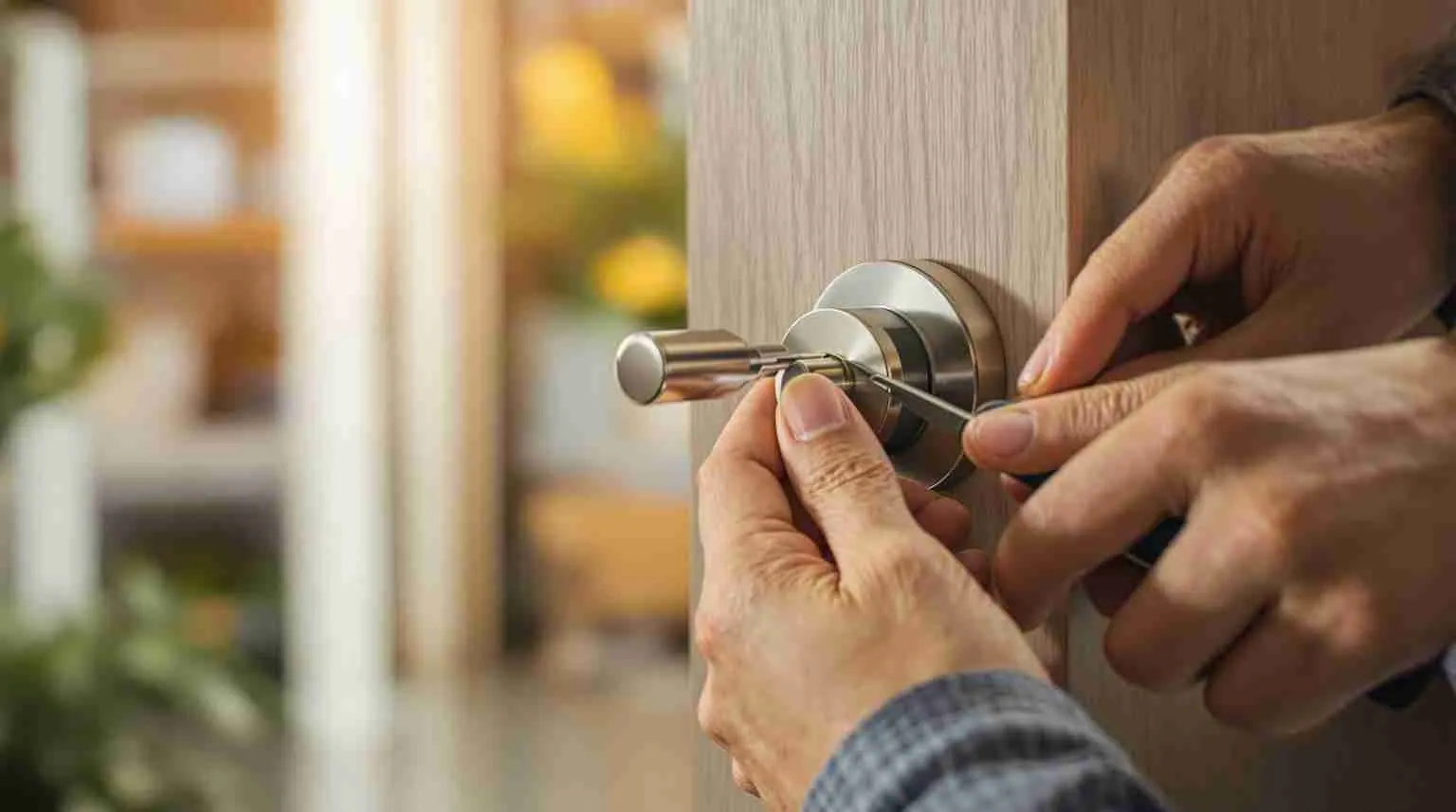
Albuquerque property managers should rekey locks between tenants as soon as the unit comes back and before the first showing: count the keys returned, rekey every lock the old keys opened, cut only the keys you will hand out, and log each one. Rekeying changes the pins inside the lock and keeps the hardware, so lost or unreturned keys stop working.[1]
That's a lot of keys in circulation. About 93,057 of Albuquerque's 243,733 occupied homes are rented, roughly 38%, in the Census Bureau's 2020 to 2024 American Community Survey.[2] Renters hold 36.4% of occupied homes in Santa Fe, 24.0% in Los Lunas and 26.8% in Belen.[3] Every lease that ends hands back keys nobody can fully count.
The landlord guides we read argue why you should rekey and stop there. This one covers the how: the order of steps around move-out, make-ready and showings, a key log kept per lock instead of per key ring, and a way to price a whole turnover before you call anyone.
When to Rekey in the Turnover Sequence
Rekey in the window between getting possession back and the first showing of the empty unit. Before move-out the resident still lives there, and New Mexico's Uniform Owner-Resident Relations Act requires 24 hours' written notice before an owner enters to show the unit to prospective residents, unless owner and resident agree otherwise.[4] After the rekey, every vendor and showing key is new and logged.
The order we recommend for a standard turnover:
- When notice to vacate arrives, pull the unit's key log. List every key issued for that lease, including mailbox, gate, garage and shared doors.
- Schedule occupied showings with written notice. Those showings use the old key. The notice states the purpose, the date and a reasonable estimate of the time frame.[4]
- Collect and count keys at move-out. Write the count on the move-out sheet next to the log.
- Rekey before vendor keys scatter. Rekey on move-out day or the next business day, then give cleaners and repair crews new, logged keys.
- Rekey every lock the old key opened. Entry knob or lever, deadbolt, back or patio door, garage entry, storage and any shared door.
- Cut only the keys you will issue. Tenant set, office, maintenance. Log each by code.
- Test every new key in every lock from outside with the door closed. Then hand the tenant set over at move-in against a signed receipt.
One rule sits above the list. Never put a key in a showing lockbox until step 4 is done; a lockbox key that also opened the door for the last tenant defeats the whole turnover. Kwikset puts the reason plainly: "the person who has your key today may not be the same person you want to have your key tomorrow".[1]
Rekey, Replace or Reset the Cylinder Yourself
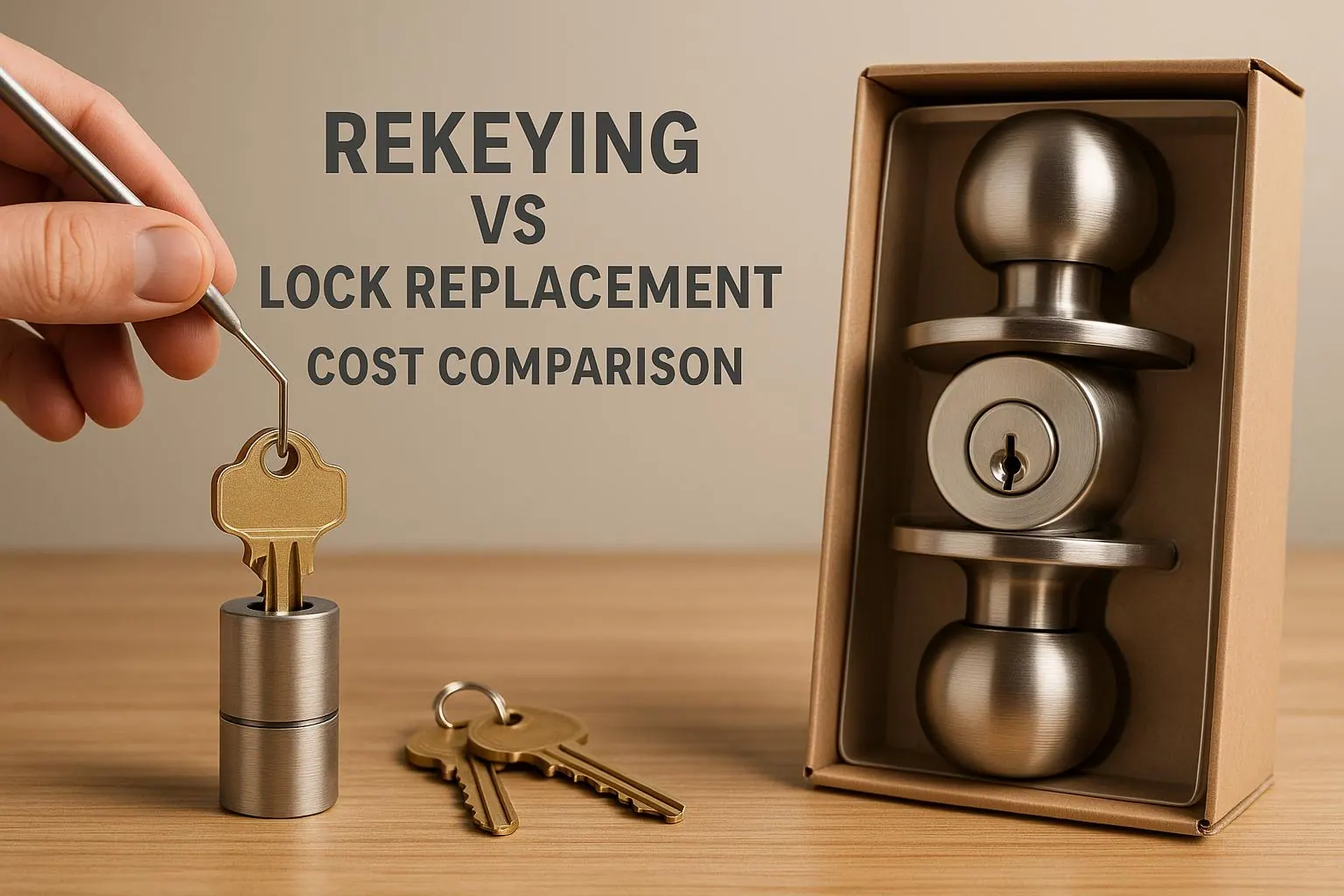
Rekey a rental lock when it works smoothly and the only problem is who holds a key. Replace it when it is worn, damaged or wrong for the door. A third route exists on Kwikset SmartKey locks: Kwikset says owners can "re-key your lock yourself in seconds" with the SmartKey tool, and its FAQ adds that the current working key is required.[1]
| Rekey (locksmith) | Replace the lockset | SmartKey reset (owner) | |
|---|---|---|---|
| What changes | The pins inside the cylinder, set to a new key | The whole lock | The cylinder, reset to a new key with the SmartKey tool[1] |
| Hardware on the door | Kept | New | Kept |
| Old keys afterward | Stop working | Stop working | Made obsolete, per Kwikset[1] |
| What you need | A locksmith and access to the door | A new lock that fits the door | The current working key, the new key and the SmartKey tool[1] |
| Master key system | Can be set up as part of one | Depends on the new lock | Not possible: Kwikset says the cylinder cannot be master-keyed[1] |
| Fits when | The lock works; the keys are the problem | The lock is worn, forced or wrong for the door | You own SmartKey hardware and still have a working key |
The SmartKey limits matter at turnover. If the departing tenant kept every copy but the office holds one, the owner can reset the lock with the tool. If no working key exists, Kwikset tells owners to contact a builder, locksmith or its support team.[1]
For the mechanics of a standard rekey, see how rekeying works. For when a worn lock is worth replacing, compare rekeying vs lock replacement.
Turnover coming up? Book a turnover rekey with Roadrunner Lock and Key. Send the unit list and the number of locks per unit, and we will quote the exact price on the phone before we come. Call (505) 347-2895
See how we work as a locksmith for property managers.
Key Control Between Turnovers
Key control between turnovers means knowing, for every lock, which keys exist and who holds them. Keep the log by lock, not by key ring: one row per cylinder, with its key code, every key cut for it, who holds each one, and when each came back. At move-out, that log tells you which locks the departing tenant's keys opened, including the shared doors.
Check the shared doors first. About half of Albuquerque's rented homes, 47,082 of 93,057, are in buildings with five or more units.[2] In those buildings, find out whether the unit key also opens a building entry, laundry or storage door. If it does, the turnover covers every lock that key opens, not one.
A basic per-lock log looks like this (example rows):
| Lock | Key code | Keys cut | Held by (date out) | Returned | Rekeyed |
|---|---|---|---|---|---|
| Unit 4B entry deadbolt | K-118 | 3 | Tenant x2 (Mar 1), office x1 | 2 of 2 tenant keys, Oct 1 | Oct 2 |
| Unit 4B entry knob | K-118 | same keys | same | same | Oct 2 |
| Laundry room | K-100 | 41 | Every tenant set | not tracked | not since 2024 |
The third row is the warning sign. A shared door whose keys were never tracked can't be closed out at turnover, so take it off the unit key or put it on its own rekey schedule.
Returned keys prove less than they seem. A tenant who returns 2 of 2 keys may still have cut copies, so the count describes the keys you issued, not the copies that exist. Kwikset lists "tenant turnover" among its reasons to rekey.[1] Rekey every turnover, even when the count matches.
When a Master Key System Makes Sense for Rentals
A master key system makes sense when staff need regular access to many units on one site and the property can keep master keys few and signed out. The trade-off is documented. Matt Blaze showed that, "Given access to a single master-keyed lock and its associated key," an attacker can work out a working master key for the system.[6] Every tenant holds exactly that.
That's the rental-specific risk. In an apartment complex every resident holds a change key, and every turnover hands a new person a master-keyed lock and its key. Blaze writes that the countermeasures he describes give only limited protection.[6]
Master keying fits a single complex where maintenance enters many units and a manager would otherwise carry a ring of keys. For scattered houses we'd do it differently. About 27,664 of Albuquerque's 93,057 rented homes, roughly 30%, are single-unit homes, detached or attached.[2] Across a portfolio of those, our recommendation is a different key for each house, with each house keyed alike inside, so the front, back and garage doors share one key. Kwikset says its SmartKey locks can be rekeyed so all entry doors are keyed alike.[1]
Before you master key a property, read our breakdown of master key system risks. A lost master means rekeying every door it opens.
What Drives the Cost of a Turnover Rekey
The cost of a turnover rekey is set by the number of cylinders, not doors, plus one visit charge and any after-hours premium. For a public benchmark, HomeYou's Albuquerque guide, updated September 27, 2026, lists home rekey services at $40 to $100 and house calls at $30 to $150 in regular hours. It does not say whether the rekey range is per lock.[5]
Build the estimate in this order:
- Count cylinders. Cylinders, not doors. A knob and a deadbolt on one door are two.
- Add the visit charge once. HomeYou lists house calls at $30 to $150 in regular hours and $100 to $250 at night, on weekends and on holidays.[5]
- Add extra keys. Each key you cut for the office and maintenance is a cost you choose.
- Name the system. If the property is master keyed or on a restricted keyway, say so on the call, because the new keys have to fit that system.
- Group units. Several vacancies on one visit share one visit charge.
Grouping changes the math more than any other choice. One visit spread across four units of two cylinders each covers 8 cylinders. At HomeYou's $30 to $150 house-call range,[5] that's $3.75 to $18.75 of visit charge per cylinder, against $15 to $75 per cylinder when a single two-cylinder unit gets its own visit. Those are HomeYou's figures run through our arithmetic, not Roadrunner's prices.
Rekeying Is a Policy Choice
New Mexico's Uniform Owner-Resident Relations Act does not require an owner to rekey between residents. We read the Act's 57 current sections as compiled on NMOneSource on October 17, 2026: the word "lock" appears once, in Section 47-8-36, which bars removing a resident without a court order by "plugging, changing, adding or removing any lock or latching device".[4]
The owner's duties in Section 47-8-20 cover housing codes, a safe condition, common areas and facilities such as plumbing and heat. They don't mention locks or keys by name.[4] The first duty folds in any applicable minimum housing code, which can carry its own lock rules, so this read covers the Act's text only.
We did not find a rule in the Act's current text that makes a landlord change locks for a resident with a protective order.[4] Senate Bill 400 of 2025, which would have added lock language for survivors of domestic violence, is listed on nmlegis.gov as died.[7] If a resident asks for a lock change for safety, answer the same day and call your attorney about the lease terms.
So the rekey is your policy. Write it into the turnover checklist and the lease. This guide is general information about locks and New Mexico's statute text, not legal advice. Talk to your attorney about your lease and your property.
Frequently Asked Questions About Rekeying Between Tenants
No question matches that. Call or text (505) 347-2895 and ask it.

Roadrunner Lock and KeyAnswers from the shop
Open 24/7
Pick a question, or search above. You get the straight answer, the way we would give it on the phone.
Do landlords typically change locks between tenants?
We found no published New Mexico count of how many landlords rekey, so we won't guess one. The text of the state's Uniform Owner-Resident Relations Act does not require it; it is a policy each owner sets. We recommend a rekey at every turnover, because no landlord can prove how many copies of a returned key exist.
Roadrunner Lock and Key
Is it cheaper to rekey locks or replace them?
Rekeying keeps the lock, so you pay for labor and new keys rather than new hardware. HomeYou's Albuquerque guide, updated September 27, 2026, lists home rekey services at $40 to $100, and lock installation at $40 to $100 at minimum with a $15 to $40 labor charge on top. Neither range is Roadrunner's price. Replacing also means buying the new lock.
Roadrunner Lock and Key
Can a tenant rekey a rental themselves?
New Mexico's Act does not mention a resident changing locks; its one lock provision limits the owner. Mechanically, Kwikset says only someone with the current working key and the SmartKey tool can rekey a SmartKey lock, so a tenant who has both can lock the office out. Put "no lock changes without written consent, and a copy of any new key to the office" in the lease.
Roadrunner Lock and Key
3 questions
Rekey Before the First Showing
The order matters more than the speed. A turnover rekey works when it runs in the same order every time: log, count, rekey before vendors and showings, cut only what you issue, test, record. The log pays off the next time a key goes missing, because it turns the loss into a short list instead of a building-wide guess.
A tenant turnover is one of the common signs you need to rekey, and the step-by-step for a standard lock is in our guide to rekeying locks at home.
Managing rentals in Albuquerque, Santa Fe or Valencia County? Send your unit list and the number of locks per unit to Roadrunner Lock and Key at (505) 347-2895 for a quote. We're a 24/7 mobile locksmith at 3803 3rd St NW, Albuquerque, and we will quote the exact price on the phone before we come. Save the number with your turnover checklist.
References
- Kwikset. SmartKey Security. No page date shown. Read October 17, 2026. kwikset.com/smartkey-security
- U.S. Census Bureau, American Community Survey 2020 to 2024 5-year estimates, tables B25003 and B25032, Albuquerque city, via the Census Reporter API. Tenure; Tenure by Units in Structure. ACS 2024 5-year release. Read October 17, 2026. api.censusreporter.org (ACS 2024 5-year, B25003 and B25032, Albuquerque)
- U.S. Census Bureau, American Community Survey 2020 to 2024 5-year estimates, table B25003, via the Census Reporter API. Tenure: Santa Fe, Los Lunas and Belen. ACS 2024 5-year release. Read October 17, 2026. api.censusreporter.org (ACS 2024 5-year, B25003, Santa Fe, Los Lunas, Belen)
- New Mexico Compilation Commission, NMOneSource. NMSA 1978, Chapter 47, Article 8, Uniform Owner-Resident Relations Act (Sections 47-8-1 to 47-8-52). Current compilation (Chapter 47 file dated July 28, 2026). Read October 17, 2026. nmonesource.com/nmos/nmsa/en/item/4408/index.do
- HomeYou. Locksmith Albuquerque costs. Updated September 27, 2026. Read October 17, 2026. homeyou.com/nm/locksmith-albuquerque-costs
- Matt Blaze. Cryptology and Physical Security: Rights Amplification in Master-Keyed Mechanical Locks. IEEE Security and Privacy, March/April 2003; IACR ePrint 2002/160. Read October 17, 2026. eprint.iacr.org/2002/160
- New Mexico Legislature. SB 400, 2025 Regular Session (bill status and introduced text). 2025. Read October 17, 2026. nmlegis.gov (SB 400, 2025)